

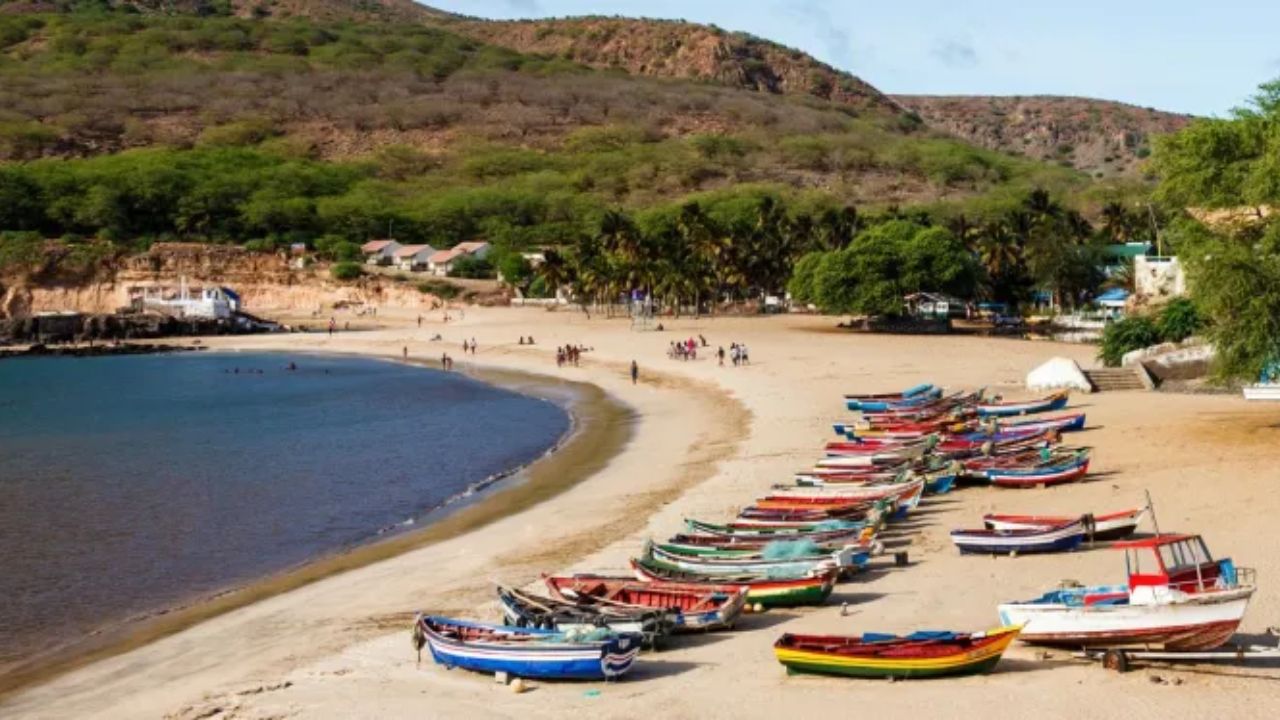
Cape Verde’s role as a crossroads of the Atlantic world begins with geography. The islands sit off the coast of West Africa, positioned between Europe, Africa, and the Americas. This location placed Cape Verde directly along the major sea routes that connected Portugal and other European powers to West Africa, Brazil, the Caribbean, and later North America.
For early Atlantic sailors, the islands offered a vital stopping point. Ships needed places to resupply with fresh water, food, and shelter after long ocean crossings. Cape Verde’s harbors became natural rest points, making the archipelago an essential node in the growing Atlantic network of trade and migration.
Table of Contents
Early Portuguese Settlement and Maritime Expansion
Cape Verde was uninhabited before the arrival of the Portuguese in the 15th century. Unlike many other Atlantic islands, there was no existing population to displace. This allowed the Portuguese to establish settlements quickly and organize the islands specifically around maritime and commercial purposes.
The islands became part of Portugal’s broader strategy of Atlantic expansion. From Cape Verde, Portuguese ships could reach the African mainland, Brazil, and Europe with relative ease. The settlement of Ribeira Grande (today Cidade Velha) on Santiago Island became one of the earliest European colonial towns in the tropics and a major Atlantic port.
Cape Verde and the Atlantic Slave Trade
One of the most significant reasons Cape Verde became a crossroads of the Atlantic world was its central role in the transatlantic slave trade. Enslaved Africans were brought from the mainland to the islands before being transported onward to the Americas.
Cape Verde functioned as both a holding point and a redistribution center. Ships regrouped, cargoes were reorganized, and crews prepared for the next stage of their journey. This made the islands a key logistical hub within a brutal global system that reshaped populations, economies, and cultures across continents.
The legacy of this period deeply influenced Cape Verdean society. The blending of African and European populations gave rise to a creole culture that remains central to the islands’ identity today.
A Meeting Place of Cultures and Peoples
As ships passed through Cape Verde, so did languages, customs, religions, and ideas. Sailors, traders, enslaved people, missionaries, and administrators all contributed to a constant flow of human movement.
This movement created a society that was neither entirely African nor European, but distinctly Atlantic. Creole languages developed, musical traditions emerged, and social structures formed that reflected the islands’ position between worlds. Cape Verde became a cultural bridge linking Africa, Europe, and the Americas long before globalization became a modern concept.
Maritime Winds and Navigation Advantages
Cape Verde’s importance was also reinforced by natural forces. The trade winds of the Atlantic made the islands a predictable and practical waypoint for sailing vessels. Navigators relied on these wind patterns to cross the ocean efficiently.
Because ships naturally passed near Cape Verde, stopping there became routine. Over time, this consistency cemented the islands’ reputation as a reliable transit point, further strengthening their role in Atlantic commerce and communication.
Decline and Transformation Over Time
As steamships replaced sailing vessels and new trade routes emerged, Cape Verde’s strategic importance declined. The end of the slave trade and shifts in global commerce reduced the islands’ role as a central hub.
However, Cape Verde did not disappear from the Atlantic world. Instead, its role transformed. Migration became a defining feature, with Cape Verdeans traveling to the Americas and Europe in search of opportunity. These diaspora communities maintained strong connections to the islands, keeping Cape Verde tied to global Atlantic networks in new ways.
A Lasting Atlantic Identity
Cape Verde became a crossroads of the Atlantic world because of its location, its role in maritime expansion, and its function within global trade and migration systems. The islands were shaped by constant movement, exchange, and adaptation.
Today, Cape Verde’s history as an Atlantic crossroads is still visible in its culture, music, language, and diaspora connections. Understanding this past helps explain why the islands feel both deeply African and unmistakably global, rooted in a history that spans oceans and continents.

Joao Fernandes is a climatologist and historian specializing in Cape Verde’s weather patterns and island history, with fifteen years at the national meteorological institute and university research. Based in Praia, Cape Verde, his professional background blends climate analysis, historical archival research, and public policy advising. His expertise covers seasonal wind and rainfall forecasts, climate resilience for coastal communities, and archival studies of colonial-era records. Joao co-authored the book “Climate and Culture of Cape Verde,” published peer-reviewed papers, and advised municipal planners on weather-informed heritage conservation.